NewsColony
Coronavirus live news: Tour de France in doubt, WHO to review emergency alert rules
Several US Midwest states reported record one-day increases in the number of new coronavirus cases as the nationwide death toll passed 180,000, and cases approached six million.
Reuters reports that Iowa, Minnesota, North Dakota and South Dakota all recorded on Thursday the biggest one-day increases in new infections since the pandemic started.
North Dakota, where cases rose 30% last week, reported a record 333 new cases on Thursday. Neighbouring South Dakota, where cases rose 50% last week, reported a record 623 new infections. Iowa reported 1,288 new cases on Thursday after seeing infections rise nearly 7% last week. Minnesota reported 1,154 new cases and saw its new cases rise 4% last week, according to a Reuters analysis. Cases were also rising in Illinois.
The Midwestern state records came as governors of several other states said they would not reduce testing as recommended the US Centers for Disease Control and Prevention, which this week advised that people who were exposed to Covid-19 but not symptomatic did not need to be tested. Critics said the change was based on political pressure and not science.
California, Connecticut, Florida, Texas, New Jersey and New York all planned to continue to test asymptomatic people who have been exposed to Covid.
The governors of New York, New Jersey and Connecticut slammed the CDC’s move as “reckless” and “not based on science,” and said they would not change testing guidelines in their states.
The CDC and Department of Health “have not shared their scientific rationale for this change in policy, which substitutes sound science-based public health guidance with the president’s misinformation,” they said in a joint statement.
President Trump has lauded his own record on coronavirus and will speak at the Republican convention in the next couple of hours.
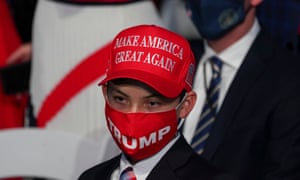
A Trump supporter at the Republican National Convention in Washington. Photograph: Kevin Lamarque/Reuters
Spanish schoolchildren aged six and over must wear masks to class, the government announced on Thursday, unveiling a plan to reopen schools just days before the start of the new academic year.
The health minister, Salvador Illa, said that, while closing down schools could become necessary if multiple cases of the virus were detected across different classrooms, that would be the last resort.
“It would have to be studied on a case by case basis. This is not black and white,” he said at a joint news conference with the ministers for education and regional policy.
Spain’s health ministry reported 3,594 new infections on Wednesday and has logged nearly 83,000 in the past two weeks. Nearly 29,000 people have died since the onset of the pandemic.
Asked whether concerned parents would have the right to keep their children at home, education minister Isabel Celaa said schools were safer than other places.
“It is mandatory to go to class. For anyone who is afraid, I must say that we have been working since day one for a safe environment,” she said, acknowledging there was no place with “zero risk.”
Prior to the announcement, Spain’s 17 regions had prepared their own back-to-school plans, all featuring variations of mask wearing, hygiene measures and reduced class sizes.

2020 students wearing face masks attend class at the Lopez de Mendoza Institute in Burgos in June. Photograph: César Manso/AFP/Getty Images
The WHO is setting up a committee of independent experts to consider changing the rules on declaring an international health emergency, following criticism of its Covid-19 pandemic response.
The world body declared a public health emergency of international concern (PHEIC) over the new coronavirus on 30 January – at which time the respiratory disease had infected fewer than 100 people outside China, and claimed no lives beyond its borders.
But under the current International Health Regulations (IHR) governing preparedness and response for health emergencies, there are no lower, intermediate levels of alert beneath a full PHEIC, either on a global or regional scale.
WHO experts had met on 22-23 January, but at that point did not conclude that the outbreak merited the high state of alert of a full PHEIC.
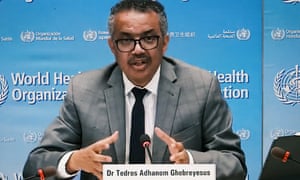
World Health Organization (WHO) Director-General Tedros Adhanom Ghebreyesus announced a committee will review the health body’s emergency alert system. Photograph: Xinhua/REX/Shutterstock
WHO director-general Tedros Adhanom Ghebreyesus told a virtual press conference on Thursday that the Covid-19 pandemic had been an “acid test” for countries as well as for the IHR.
Tedros that even before the coronavirus pandemic, emergencies such as the Ebola outbreak in the eastern Democratic Republic of the Congo had exposed flaws in the IHR.
Such emergencies showed that “some elements of the IHR may need review – including the binary nature of the (alert) mechanism,” Tedros said.
The committee will present a progress report to the World Health Assembly – the WHO’s decision-making body, made up of member states – in November, and a full report to the assembly in May.
One of Europe’s most iconic event, the Tour de France, is in doubt after the race’s starting region, the Alpes-Maritimes, was put on red alert.
The Guardian’s Jeremy Whittle reports that tensions surrounding the race ramped up further still on Thursday evening after the Lotto-Soudal team announced two of their team’s support staff has tested “non-negative” for Covid-19 and had been sent home from Nice. “Safety remains priority number one,” the statement read.
“Only world wars have stopped the Tour de France,” the Tour director, Christian Prudhomme, said in March this year, but the rapidly growing concerns over the wisdom of going forward with this year’s race led to a cross-examination of the prime minister, Jean Castex, by journalists on Thursday.

Dylan Van Baarle of the Dutch team INEOS Grenadiers/Statue of Apollo rides in Nice. Photograph: Tim de Waele/Getty Images
“We have taken numerous precautions and health protocols and I’d remind you that this is an open-air event,” Castex said. “The places where the virus spreads and there is transmission have no organisation. The Tour has an organiser.”
Confirming that Nice was one of 19 new regions to be placed under red alert, Castex stated that “the pandemic is regaining ground and now’s the time to intervene”, adding: “France must do everything to prevent a new lockdown.”
With uncertainty over race gripping the Grand Départ bubble of riders, some teams have hinted they will race day by day, while others have insisted it will not change their long-term tactics.
“We don’t have a strategic plan to be in the lead in case the race stops after one and a half weeks,” Tom Dumoulin, former Giro d’Italia champion, and teammate to Primoz Roglic, said.
On Thursday France reported its second-highest level of cases ever and a new post-lockdown high, with 6,111 cases. The highest daily total of 7,578 was set on 30 March.
You can read Jeremy’s full report on the Tour below.
Source: The Guardian |NewsColony
The post Coronavirus live news: Tour de France in doubt, WHO to review emergency alert rules appeared first on NewsColony.
NewsColony
source https://newscolony.com/coronavirus-live-news-tour-de-france-in-doubt-who-to-review-emergency-alert-rules/
Comments
Post a Comment